Shake Off Annoying Hand Tingling with These Targeted Stretches

Hand Tingling Exercises Can Help - When You Keep Them Gentle

A gentle hand tingling exercise routine can help ease mild, activity-related pins-and-needles by improving movement in the wrist, fingers, forearm, neck, and shoulder. Start with these simple steps:

  1. Straighten your wrist and relax your grip for 20 to 30 seconds.
  2. Slowly open and close your hand 5 to 10 times.
  3. Do a few gentle nerve glides without pushing into pain or stronger tingling.
  4. Take a break from the activity that triggered symptoms, then check your wrist angle, posture, and equipment grip.

Hand tingling often follows sustained gripping, bent wrists, pressure on handlebars or weights, repetitive work, or tightness higher in the neck and shoulder. It can also come from nerve irritation at the wrist, elbow, or cervical spine - so the right exercise depends on where the nerve is being stressed.

The key is not to stretch aggressively or "push through" numbness. Mild symptoms that settle with rest and position changes may respond well to short, consistent mobility work. Tingling that is constant, worsening, wakes you at night, or comes with weakness deserves a medical evaluation.

I am Sonny Dosanjh, M.D., a board-certified Physical Medicine and Rehabilitation physician and fellowship-trained pain specialist. In my work with sports injuries, spine conditions, and nerve-related pain, I use hand tingling exercise strategies as one part of a personalized, non-surgical plan to restore comfortable movement and function.
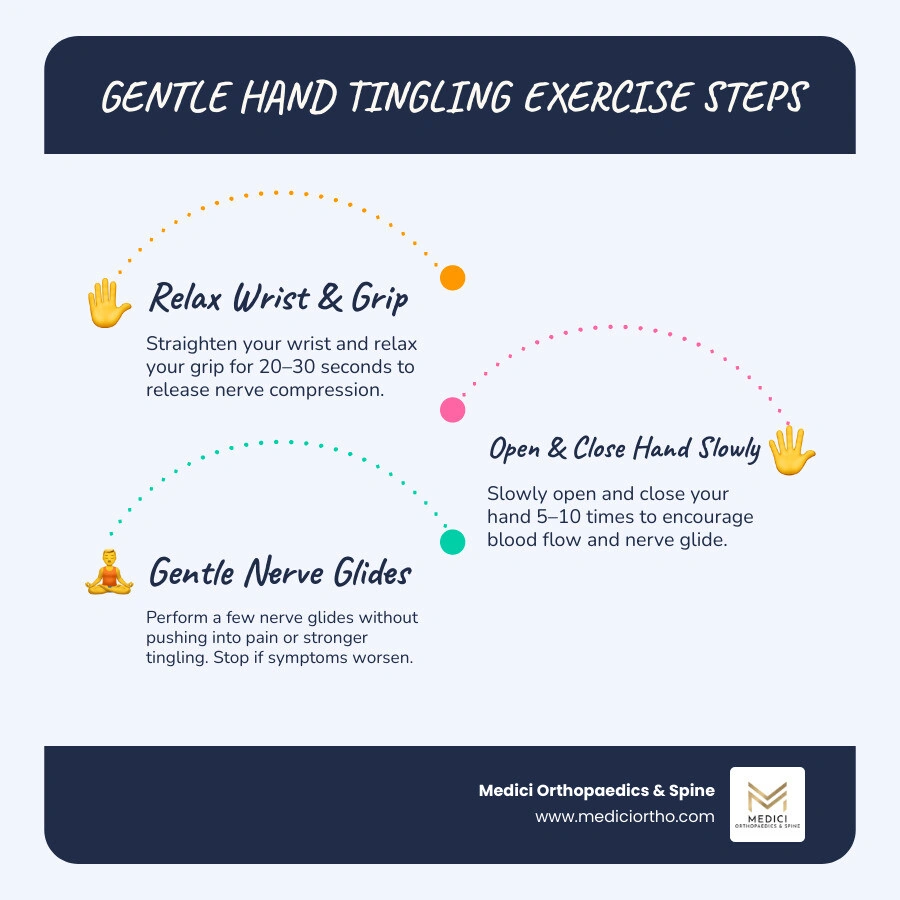
Infographic showing gentle hand exercises, posture checks, and signs to seek medical care infographic

Relevant articles related to hand tingling exercise:

What Causes Hand Tingling During and After Exercise?

When you feel a sudden "static" or pins-and-needles sensation during or after a workout, your nervous system is waving a tiny yellow flag. In our practice across the Atlanta metro area, we see this frequently in runners, cyclists, gym enthusiasts, and desk workers alike. Hand tingling (medically termed paresthesia) during exercise typically stems from three primary physiological events:

  • Blood Flow Redistribution: During intense cardiovascular workouts or weight lifting, your body prioritizes large, working muscle groups—such as your quadriceps or core—redirecting blood flow away from the extremities. Long-distance running can also lead to minor fluid pooling in relaxed hands due to centrifugal force from arm swings, causing transient puffiness that compresses local nerve endings.
  • Mechanical Grip Pressure and Poor Wrist Angles: Clamping onto a barbell, gripping kettlebells with a bent wrist, or leaning heavily on bicycle handlebars exerts direct, sustained pressure against superficial nerve channels in your palms and wrists.
  • Repetitive Strain and Postural Compression: Repetitive motions, combined with forward-head posture and rounded shoulders, compress neurovascular bundles as they leave the cervical spine and traverse the shoulder, armpit, and forearm.

Understanding what causes nerve pain in your hands helps differentiate between benign exercise-induced sensations—which usually resolve within 5 to 10 minutes of resting—and true mechanical entrapment requiring targeted intervention.
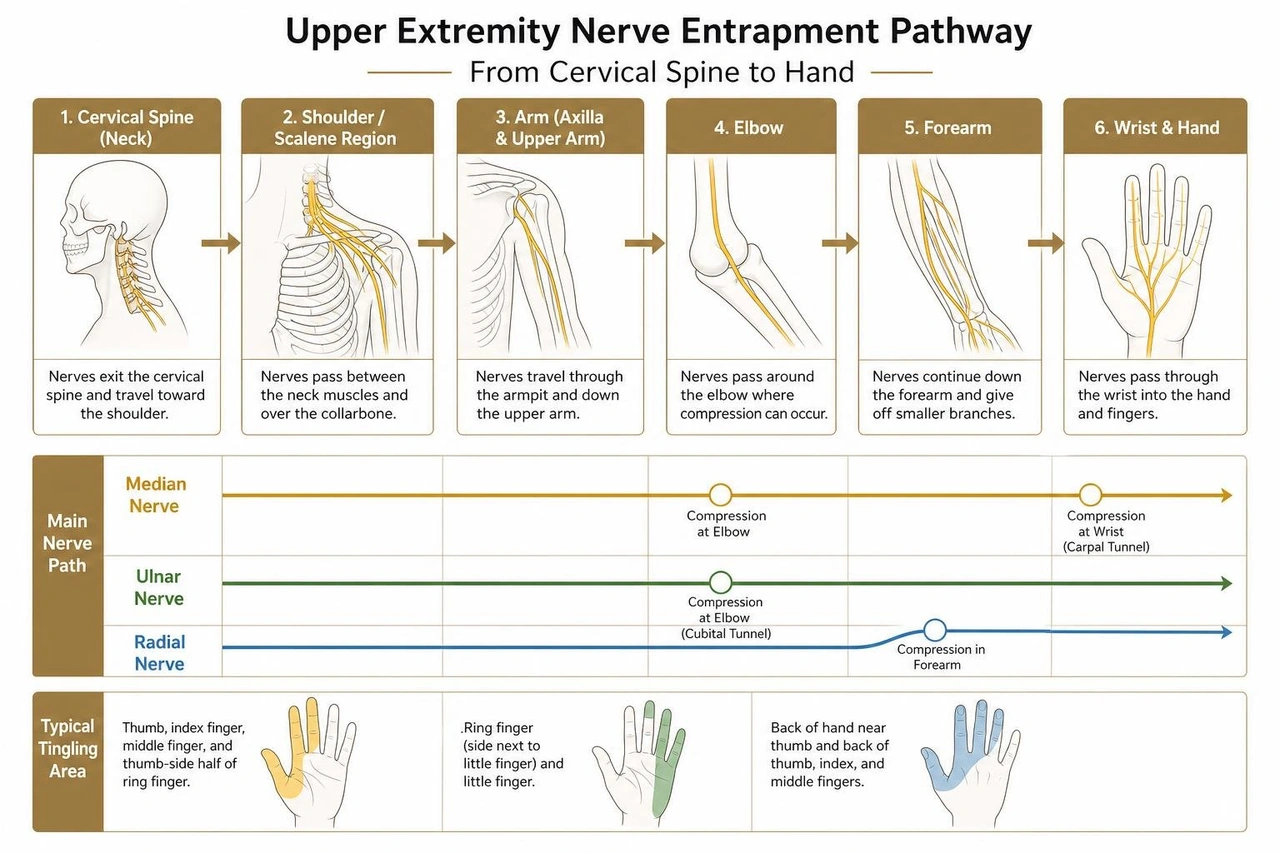
Upper extremity nerve entrapment pathway from cervical spine to hand

Median vs. Ulnar vs. Radial Nerve Entrapment

Your hand is innervated by three main peripheral nerves, each tracing a unique pathway from your neck down to your fingertips. Irritation at different entrapment sites creates distinct sensory patterns:

  1. Median Nerve (Carpal Tunnel): Runs through the anterior forearm and passes beneath the transverse carpal ligament at the wrist. It supplies sensation to your thumb, index finger, middle finger, and the thumb-side half of your ring finger. Compression here frequently triggers persistent fingertips tingling, particularly noticeable during computer typing or sustained gripping.
  2. Ulnar Nerve (Cubital Tunnel & Guyon's Canal): Passes behind the inside of your elbow (the "funny bone") and enters the wrist through Guyon’s canal. Compression causes classic numbness, tingling, and aching across the pinky finger and the outer edge of the ring finger. This is common in cyclists who bear weight on the heel of their hands or athletes who spend prolonged periods with bent elbows.
  3. Radial Nerve (Radial Tunnel): Travels down the back of the arm and outer forearm. Entrapment typically manifests as dull aching, tingling, or sensory loss on the back of the hand, web space between the thumb and index finger, and posterior forearm.

Nerve Gliding vs. Tendon Gliding: Key Differences

Patients often ask us whether they should perform nerve glides or tendon stretches. While both promote healthy mobility through anatomical tunnels, they serve entirely different mechanical functions.

Nerves are living communication cables that dislike high tension; they require gentle, rhythmic sliding movements to restore blood supply and disperse inflammatory fluids. Tendons, by contrast, are fibrous cords connecting muscle to bone that can tolerate higher tensile loads and require excursion through their protective sheaths to prevent scar tissue formation.

For the complete clinical management of hand and wrist pain and injuries, combining both techniques in a structured, pain-free sequence yields optimal tissue excursion.
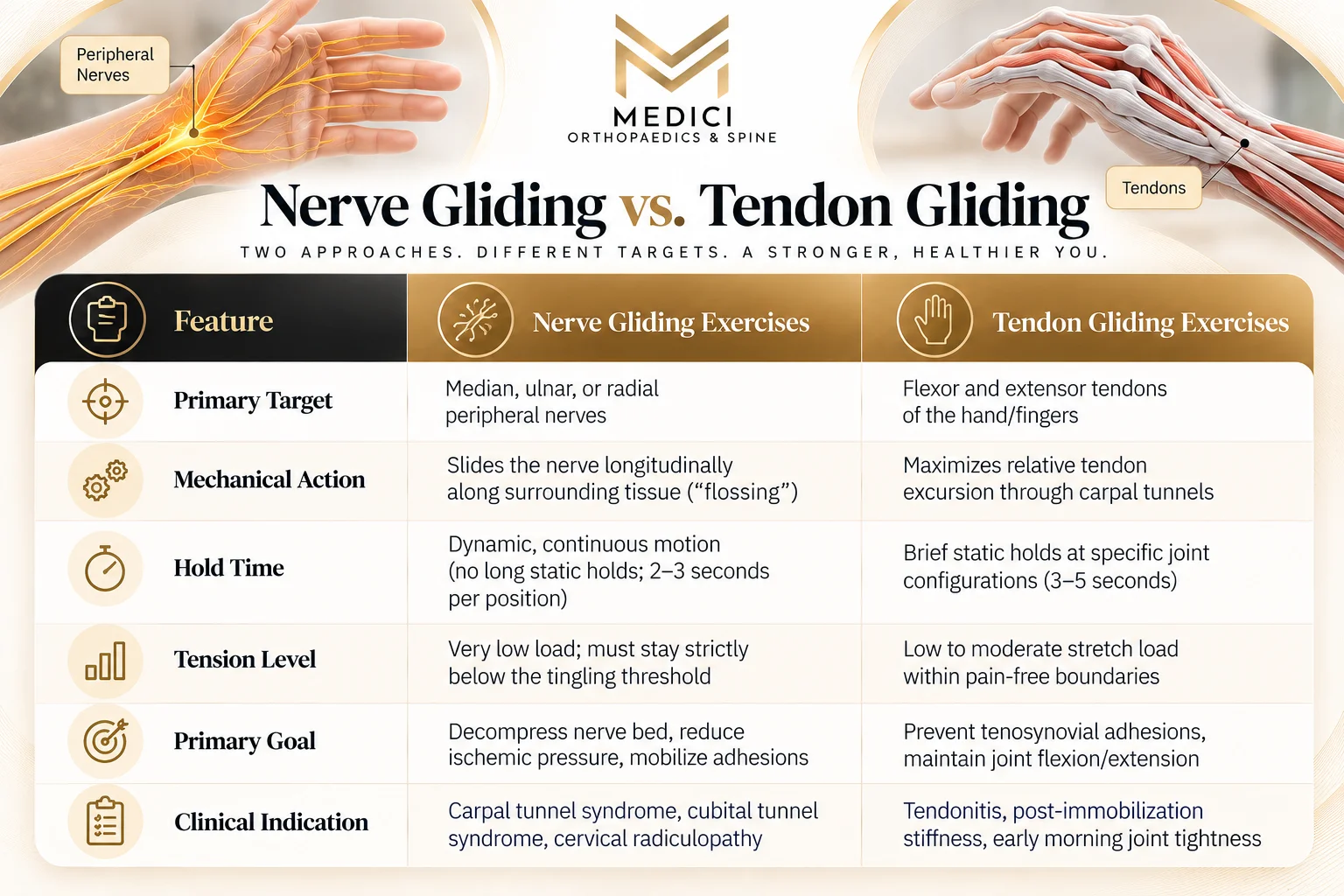
Nerve vs. hand tingling exercise infographic with gentle stretches and posture tips.

Master Every Essential Hand Tingling Exercise for Nerve Relief

Nerves require three things to function without symptoms: space, movement, and blood flow. When surrounding muscles, fascial layers, or ligaments become tight, the nerve gets snagged rather than sliding freely.

A helpful way to visualize nerve flossing is imagining a cooked spaghetti noodle moving smoothly through a wide straw. If the noodle dries out or the straw gets squeezed, friction increases. The following sequence restores that effortless glide.
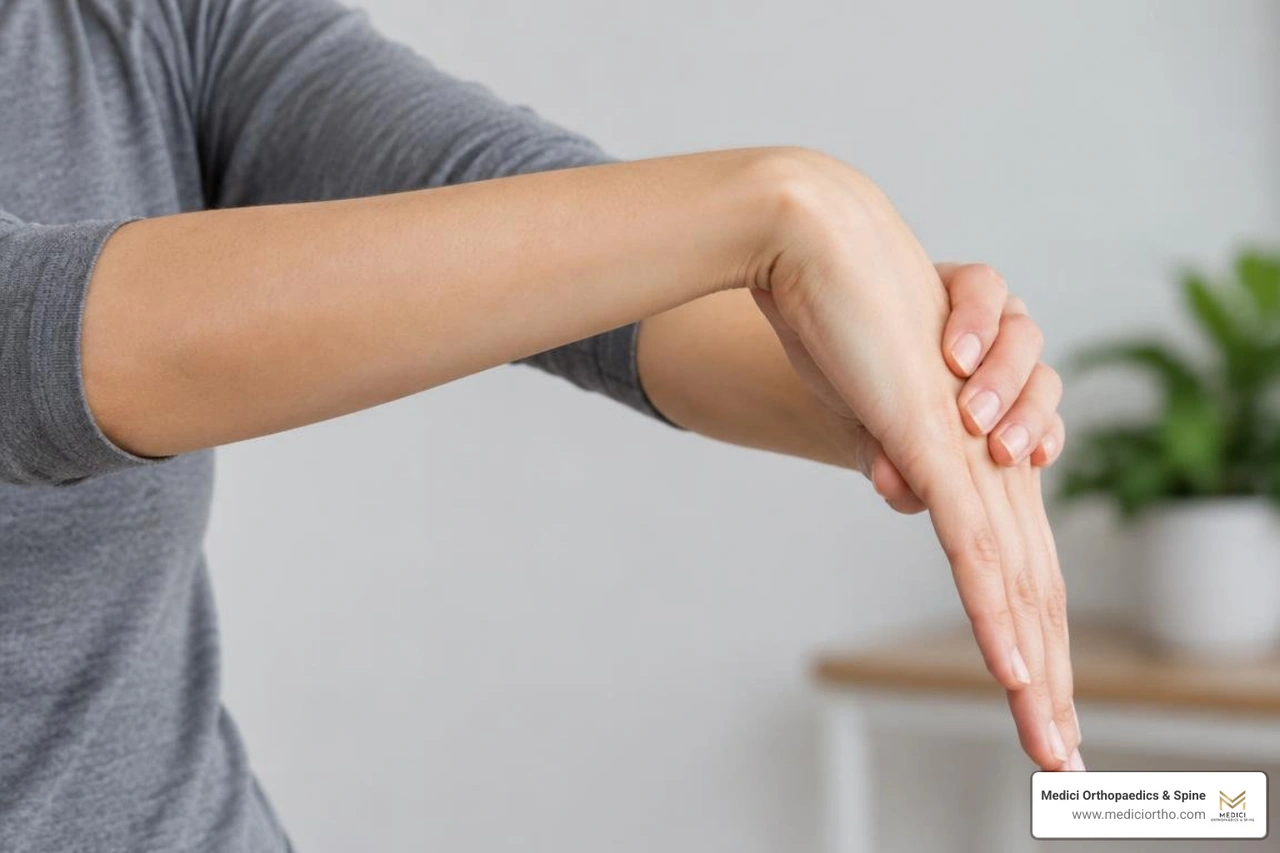
Demonstration of gentle nerve flossing and gliding movements

Median Nerve Flossing: The Primary Hand Tingling Exercise

Clinical trials of nerve-gliding and tendon-gliding exercises show low- to moderate-certainty evidence of symptom improvement in mild to moderate carpal tunnel syndrome, making it an excellent first-line movement. It should always be performed as a flowing motion rather than an aggressive stretch.

For individuals exploring targeted carpal tunnel syndrome treatment protocols, this six-step dynamic sequence is foundational:

  1. Neutral Fist: Hold your hand in front of your chest, elbow bent at 90 degrees, forming a soft, relaxed fist with your thumb resting lightly outside your fingers.
  2. Finger Extension: Gently straighten all five fingers upward, keeping them together in a high-five position while keeping the wrist straight.
  3. Wrist Extension: Keeping your fingers straight, slowly bend your wrist back toward your forearm as far as comfortably possible without straining.
  4. Thumb Abduction: Maintain the extended wrist and gently spread your thumb outward to the side.
  5. Forearm Supination: Slowly rotate your forearm so your palm faces toward your body/ceiling.
  6. Gentle Traction (Optional): With your opposite hand, gently guide the thumb into a slightly deeper stretch for 2 seconds, then return to the starting position.

Dosing: Perform 5 to 10 repetitions smoothly, 2 to 3 times per day. If you begin to feel tingling during step 3 or 4, do not push further—reduce the range of motion until the sensation remains quiet.

Ulnar and Radial Nerve Mobilization Protocols

When tingling concentrates along the pinky side or the top of the hand, targeted glides for the ulnar and radial nerves help clear pathway restrictions at the elbow and forearm.

Ulnar Nerve Flossing ("The Mask" or "OK Sign")

  1. Stand or sit tall with your arm extended out to the side at shoulder height, palm facing forward.
  2. Bring the tip of your index finger and the tip of your thumb together to form an "OK" circle, keeping your remaining three fingers relaxed and straight.
  3. Slowly bend your elbow, bringing your hand toward your face, and rotate your wrist so you place the "OK" circle around your eye like a pair of glasses or a masquerade mask (fingers pointing downward/backward).
  4. Hold the position for 2 seconds, then slowly reverse the movement back to the starting position.
  5. Perform 5 to 8 slow, rhythmic repetitions.

Radial Nerve Mobilization ("Waiter's Tip Glide")

  1. Stand with your arm resting at your side, elbow straight.
  2. Rotate your arm inward (internal rotation) so your thumb points backward behind you.
  3. Flex your wrist backward toward the ceiling, bending your fingers slightly into your palm (mimicking a waiter discreetly accepting a tip behind their back).
  4. Gently depress your shoulder blade downward while tilting your head slightly to the opposite shoulder to create a subtle neural glide.
  5. Release the wrist flexion as you return your head to neutral.
  6. Repeat 5 to 10 times in an unhurried, flowing rhythm.

For individuals managing concurrent joint stiffness, combining these neural glides with broader mobility drills ensures total upper extremity mobility.

Whole-Arm Posture Stretches: Neck and Shoulder Decompression

Irritation at the wrist is often exacerbated by upstream compression at the cervical spine (nerve roots C6–T1) or thoracic outlet. Integrating gentle posture and upper-body decompression stretches ensures your nerves have room to breathe along their entire anatomical pathway.

  • Scalene Neck Stretch: Sit tall with your shoulders relaxed. Lower your right hand to anchor onto your chair seat. Gently tilt your left ear toward your left shoulder until you feel a light stretch along the right side of your neck. To target the anterior scalene where the brachial plexus emerges, rotate your chin slightly upward toward the ceiling. Breathe deeply for 20 to 30 seconds, then switch sides.
  • Scapular Retractions: Sit or stand with your arms bent at 90 degrees by your sides. Gently pull your shoulder blades together and downward, as if tucking them into your back pockets. Avoid shrugging your shoulders upward. Hold for 5 seconds, relax, and repeat 10 times.
  • Seated Chin Tucks: Sit upright with your back supported. Keeping your eyes focused straight ahead, glide your chin horizontally backward (creating a slight "double chin") without tilting your head down. Hold for 3 to 5 seconds to decompress the suboccipital and lower cervical nerve exits. Repeat 8 to 10 times.

Ergonomic Adjustments and Supportive Tools Beyond Exercise

Exercises work best when paired with daily mechanical relief. If you perform 5 minutes of nerve flossing but spend 8 hours leaning on your wrists at an awkward desk or sleeping with hyper-flexed fists, your nerves remain constantly irritated.

Workstation Setup and Sleep Positioning

  1. Maintain Neutral Wrist Alignment: Adjust your office chair and desk height so your forearms rest parallel to the floor, forming a 90-to-100-degree angle at the elbows. Your wrists should hover naturally straight rather than cocked backward (extension) or dropped forward (flexion) while typing or mousing.
  2. Avoid Resting on Hard Edges: Resting your wrists on sharp desk edges or hard laptop casings creates focal pressure on the carpal tunnel and Guyon’s canal. Use floating forearm supports or soft wrist rests positioned at the base of the palm, not over the carpal tunnel itself.
  3. Nighttime Neutral Splints: Somewhere between 3 and 6 percent of adults deal with carpal tunnel syndrome at some point, and symptoms frequently spike around 2:00 to 3:00 a.m. Night splints have moderate-quality trial evidence for reducing nighttime symptoms within a few weeks by holding the wrist in a neutral 0-to-5-degree position, preventing involuntary wrist curling during sleep.
  4. Incorporate Micro-Breaks: Every 30 to 45 minutes, pause your work for 20 seconds. Straighten your wrists, shake your hands gently, and perform 3 slow median nerve glides. Discovering complementary natural remedies to relieve tingling in hands can provide added daily support alongside ergonomic improvements.

Structuring Your Daily Hand Tingling Exercise Routine

Consistency, not intensity, is the driving factor in nerve health. It takes about three to four weeks for patients who consistently do their hand exercises to experience noticeable relief.

Here is a practical, sustainable schedule to implement:

  • Morning (2 Minutes): Upon waking, perform 5 gentle wrist extensor stretches and 5 median nerve glides to clear nighttime fluid stagnation.
  • Midday Work Breaks (1–2 Minutes Each): Complete 5 tendon glides and 5 chin tucks midway through your morning and afternoon work blocks.
  • Pre-Workout / Post-Workout: Warm up your wrists with open-and-close fist cycles before lifting or cycling. If you experience minor post-exercise pins-and-needles, shake out your hands and perform the waiter's tip or median nerve flossing routine.
  • Evening (3 Minutes): Complete a seated scalene neck stretch (30 seconds per side) and apply your neutral night splints prior to falling asleep if nighttime waking is an issue. Additional video demonstrations like Numb Hands or Tingling? 3 Nerve Glides That Fix Median ... can serve as quick evening follow-alongs.

When to See a Specialist: Neuropathy and Red Flags

While gentle home exercises provide substantial relief for mild to moderate nerve compression, they are not a substitute for medical evaluation when deeper nerve pathology is present. Carpal tunnel syndrome affects 1 to 5 percent of the general population and is roughly three times more common in women than men. When compression goes untreated for too long, mechanical pressure can lead to axonal damage.

Consult a spine or orthopedic specialist if you notice any of these red flags:

  • Symptoms Lasting Longer than 4 Weeks: Tingling or numbness that persists despite consistent stretching and ergonomic modifications.
  • Constant Numbness: Sensation changes that no longer come and go with activity, but remain permanently present throughout the day.
  • Grip Strength Decline & Clumsiness: Dropping coffee mugs, struggling with doorknobs, or difficulty buttoning shirts, which warrants evaluating finger coordination loss and nerve damage.
  • Visible Muscle Wasting (Thenar Atrophy): Thinning or flattening of the muscular fleshy pad at the base of your thumb.
  • Systemic Neuropathy Symptoms: Symmetrical numbness or burning spreading across both hands and feet, which may indicate diabetic or metabolic neuropathy.

At Medici Orthopaedics & Spine, our medical team—led by Dr. Sonny Dosanjh across our Atlanta, Snellville, Kennesaw, Marietta, and Buckhead clinics—specializes in diagnosing the exact source of nerve compression using comprehensive physical exams, electrodiagnostic nerve conduction studies (EMG/NCS), and advanced imaging. We provide an array of conservative, synergistic options ranging from targeted physical therapy, myofascial release, and image-guided injections to interventional spine care and minimally invasive decompression procedures.

Frequently Asked Questions About Hand Tingling Exercises

How long does it take for hand tingling exercises to work?

For mild to moderate nerve irritation, most patients begin noticing reduced frequency and severity of tingling within 3 to 4 weeks of consistent, daily exercise. Because nerve tissues heal and adapt gradually, maintaining a regular routine of gentle glides and ergonomic positioning is essential for lasting relief.

Can doing nerve glides make my hand tingling worse?

Yes, if they are performed too aggressively or held as static, end-range stretches. Nerves have a low threshold for mechanical stretch; over-straining an already inflamed nerve reduces its microvascular blood supply and triggers symptom flare-ups. If an exercise creates sharp pain, electric sensations, or increased numbness, immediately reduce the motion's range and speed, keeping all movements well below the symptom threshold.

What is the flick sign and does it mean I need surgery?

The "flick sign" is an involuntary or habitual reaction where an individual vigorously shakes or flicks their wrist—much like shaking down a glass thermometer—to temporarily relieve hand numbness and tingling. While it is a classic diagnostic indicator of carpal tunnel syndrome, having a positive flick sign does not automatically mean you need surgery. Most cases improve with conservative therapies including night splinting, nerve gliding exercises, activity adjustments, and anti-inflammatory medical management.

Conclusion

Hand tingling during or after daily activities does not have to sideline your workouts or disrupt your work. By understanding the underlying nerve pathways, recognizing the early signs of entrapment, and implementing gentle, consistent mobilization drills, you can effectively calm irritated nerves and restore comfortable, pain-free mobility.

Remember: never force through tingling or numbness. Keep your movements smooth, unhurried, and supported by proper ergonomics. If your hand numbness persists, progressively worsens, or interferes with your daily strength, schedule an appointment with our specialist team at Medici Orthopaedics & Spine in Snellville, Kennesaw, Marietta, Buckhead, or Atlanta to receive a comprehensive clinical assessment, or explore how to relieve tingling sensation in hands naturally through our patient care programs.

Tired of Feeling
Like Just Another
Chart?

At Medici, you’re more than your MRI.
We take time to hear your story, understand your pain, and create a plan that actually works for you.

Smiling woman with blonde hair wearing navy medical scrubs with hands behind her back.