
If you're trying to figure out how to sleep with shoulder pain on both sides, here are the positions and strategies that work best:
Waking up with pain in both shoulders is a different challenge than dealing with one. Most sleep advice focuses on protecting the "bad" side — but what do you do when there is no good side to roll onto?
This is more common than people realize. About 60% of adults are side sleepers, and nearly one-third of adults experience shoulder pain related to sleep position. When pain strikes both sides, the usual fix — rolling onto the healthy shoulder — simply isn't available.
The result is a cycle that's exhausting: you shift to relieve one shoulder, compress the other, and end up tossing all night. Research confirms that patients with chronic shoulder pain lasting more than three months have significantly higher rates of insomnia — meaning poor sleep and shoulder pain feed each other in a loop that's hard to break without a clear plan.
I'm Sonny Dosanjh, M.D., board-certified in Physical Medicine & Rehabilitation and fellowship-trained in Multidisciplinary Pain Management at Emory University, and I've helped many patients at Medici Orthopaedics & Spine find practical, non-surgical solutions for exactly this kind of bilateral shoulder discomfort — including specific guidance on how to sleep with shoulder pain on both sides without relying on medications alone. In the sections below, I'll walk you through the positions, pillow setups, and pre-bed routines that can actually make a difference tonight.
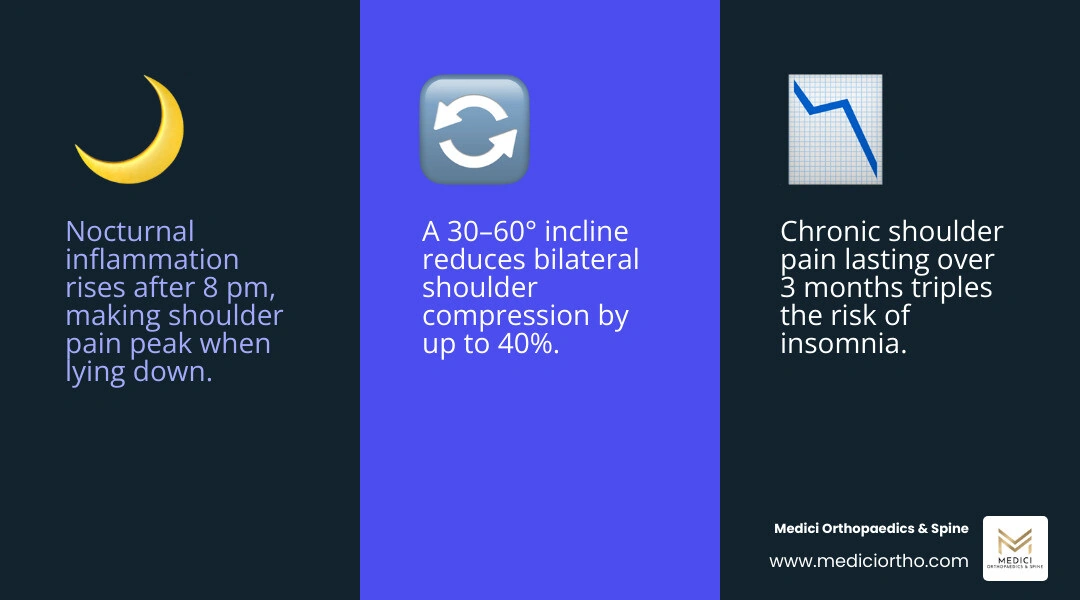
Have you ever wondered why your shoulders might feel relatively manageable during your busy day in Atlanta, only to transform into a throbbing, aching mess the moment you lie down? It feels like a cruel trick of biology, but there are clear, physiological reasons why nighttime makes shoulder pain so much worse.
During the day, your arms hang down naturally. Gravity gently pulls your shoulder joints downward, creating a small amount of traction that keeps the joint space open. However, when you lie flat on your back, that natural downward traction disappears.
Without gravity acting as a natural spacer, the tendons and bursa (the fluid-filled sacs that cushion your joints) are subjected to sustained pressure. Furthermore, when you are active during the day, your shoulder muscles constantly contract and relax. This movement acts as a natural pump, flushing out metabolic waste and preventing inflammatory fluid from pooling. When you lie still for hours, this pump shuts off, causing inflammatory chemicals to accumulate inside the joint capsule, resulting in that classic "stiff and throbbing" sensation by 2:00 AM.
Our bodies operate on a strict circadian rhythm. Cortisol, our natural anti-inflammatory hormone, naturally dips to its lowest levels in the early morning hours. With less cortisol circulating in your system, any underlying inflammation from a rotator cuff injury, bursitis, or general Shoulder Pain becomes far more noticeable and painful.
Chronic shoulder pain impacts about 8% of the general population. Because the shoulder is a highly mobile joint that relies heavily on soft tissue for stability, it is incredibly sensitive to pressure. When both sides are inflamed, sleep fragmentation is almost guaranteed. This lack of restorative sleep lowers your pain threshold the following day, making you more sensitive to the same physical sensations. Over time, this cycle can lead to chronic sleep deprivation, which actively delays your body's ability to heal.
When you are dealing with bilateral shoulder pain, standard sleep advice goes out the window. If you only had one painful shoulder, we would simply tell you to sleep on your healthy side. But when both shoulders are screaming, side sleeping becomes a high-stakes game of "pain rotisserie"—where every roll only serves to irritate the other joint.
If you are a habitual side sleeper, you are in the majority—60% of adults prefer this position. However, side sleeping is exceptionally hard on compromised shoulders.
Consider these statistics:
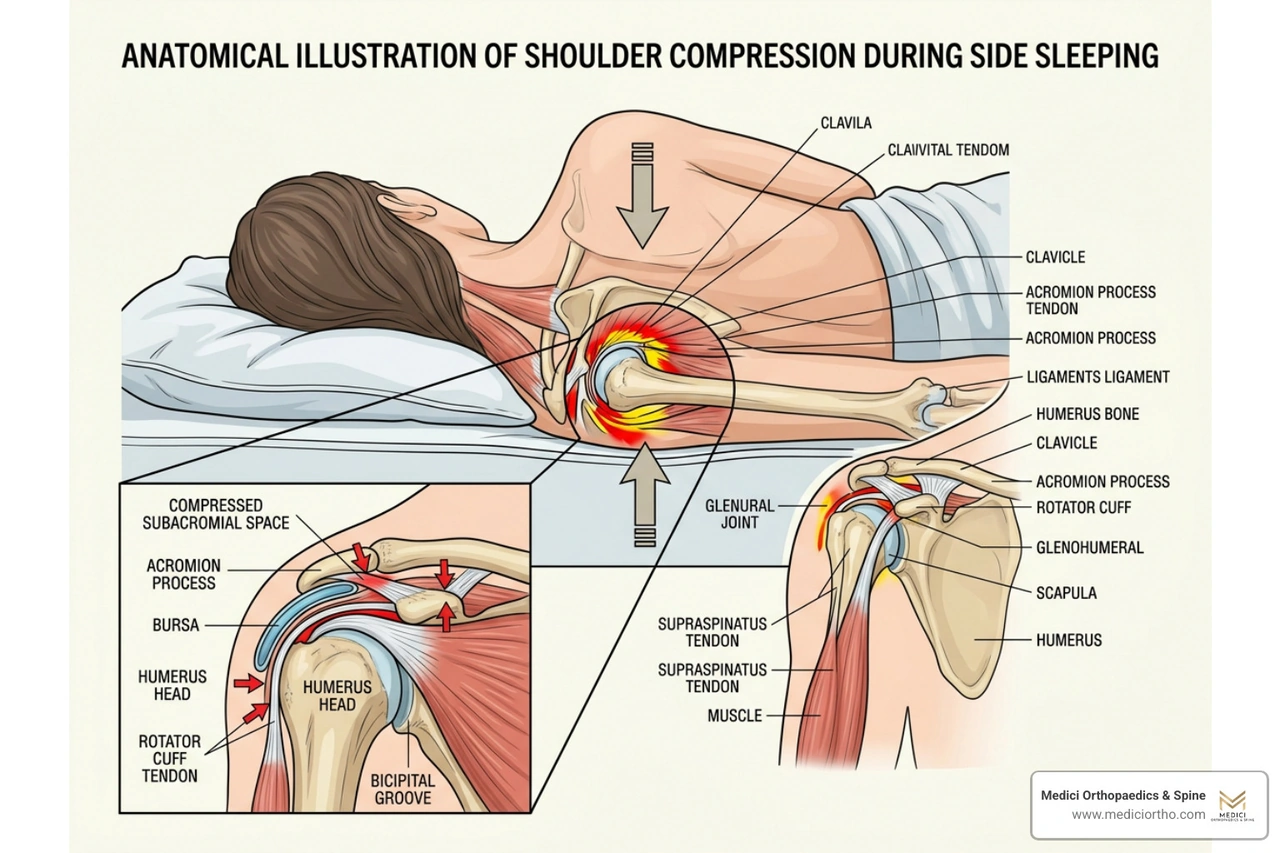
Lying directly on your side places the entire weight of your torso onto a single shoulder joint, compressing the subacromial space and cutting off local blood flow. If you try to swap sides to give the first shoulder a break, you immediately compress the second one.
Worse yet, the "top" shoulder doesn't get a free pass either. If your top arm drapes forward across your chest while you sleep, it pulls the shoulder blade out of position and overstretches the tendons on the back of the joint, leading to a dull, aching strain by morning. If you are dealing with active Frozen Shoulder or severe Shoulder Arthritis and Osteoarthritis, side sleeping should be completely off-limits until the acute inflammation subsides.
The absolute safest, most shoulder-friendly position when both sides hurt is sleeping on your back. Lying flat on your back distributes your body weight evenly across your spine and hips, taking the direct compression load off your shoulder joints.
However, simply lying flat on your back with your arms pinned at your sides can still cause discomfort. In this position, your elbows tend to drop backward toward the mattress, which pulls the front of your shoulders into an overstretched, extended position. To prevent this, we must use strategic pillow support to keep the joints in a neutral, relaxed alignment.
To survive the night with bilateral shoulder pain, you need to treat your bed like a custom orthotic device. With the right pillow configuration, you can offload pressure from both joints simultaneously.
Before you settle into your pillow setup, we highly recommend taking seven minutes to calm your nervous system and lubricate your joints. This simple routine can reduce nighttime pain levels by up to 40%:
For a visual guide on executing these protective movements safely, you can watch this instructional video: Sleep Better TONIGHT! How To Sleep With Shoulder Pain - YouTube.
Integrating these routines with targeted Physical Therapy for Joint Pain can drastically improve your mobility. If you also experience lower back stiffness from trying to stay flat on your back, incorporating some Exercises You Can Do for Lower Back Pain Relief can make back sleeping far more tolerable.
| Pillow Type | Best For | Pros | Cons |
|---|---|---|---|
| Wedge Pillow | Severe rotator cuff pain, arthritis, post-op | Reduces gravitational pull; improves circulation | Can take time to get used to |
| Body Pillow | Transitional side sleepers | Excellent for supporting the "top" arm | Hard to use if you need to support both sides |
| Ergonomic Contour Pillow | Neck and shoulder alignment | Keeps neck neutral; prevents head from tilting | Highly specific shape; less versatile |
| Standard Down/Fiberfill | Custom "arm rests" | Easily moldable; cheap and widely available | Flattens out during the night; needs fluffing |
If flat back sleeping still feels too intense, a wedge pillow is your best friend. Sleeping on a gentle 30-to-60-degree incline is a game-changer for double shoulder pain.

When your torso is elevated, the weight of your upper body is shifted downward toward your hips rather than resting directly on your upper back and shoulders. This elevation improves systemic circulation, reduces localized swelling, and prevents the pooling of inflammatory fluids in the joint capsule.
Furthermore, a slight incline is highly recommended as a Non-Surgical Treatment for Shoulder Arthritis because it keeps the glenohumeral joint in a semi-weighted state, reducing bone-on-bone friction that worsens when lying completely flat.
If you are a active sleeper who constantly tosses and turns, you need to build a physical barrier to keep yourself from rolling onto your sore shoulders. We call this the "pillow fort" technique.
To build your fort, place two long, firm pillows (or body pillows) tightly against both sides of your torso. When you lie down on your back, tuck your elbows slightly underneath these side pillows. This serves two purposes:
This structural support is especially crucial as we age. Around 30% of adults over 60 experience rotator cuff injuries, making joint protection during sleep a vital part of long-term joint preservation.
While adjusting your pillows and optimizing your sleep posture can provide immense relief, sleep modifications alone cannot heal a structural tear or reverse advanced joint degeneration. It is vital to recognize when your body is signaling that it needs professional medical attention.
You should seek a comprehensive evaluation from an orthopedic specialist if you experience any of the following:
According to current July 2026 clinical guidelines, early conservative intervention is the gold standard for managing bilateral shoulder issues. At Medici Orthopaedics & Spine, we believe that Not Every Shoulder Injury Needs Surgery: What to Know Before You Panic. In fact, the vast majority of patients with bilateral shoulder pain achieve lasting relief and restore their sleep quality through targeted, non-surgical therapies.
Whether it's customized Physical Therapy for Rotator Cuff Injuries, regenerative medicine, or targeted interventional injections to calm joint inflammation, we focus on identifying the root cause of your pain to get you back to sleeping soundly.
When you lie down, the pressure inside your shoulder joints naturally increases due to the lack of gravitational traction. Additionally, the complete lack of movement causes inflammatory fluids to accumulate within the joint capsule. If you have an underlying condition like bilateral bursitis or early-stage osteoarthritis, this combination of static compression and fluid pooling irritates the local nerve endings, resulting in a deep, throbbing ache that only appears when you try to rest.
During an acute flare-up, yes—we strongly advise avoiding side sleeping entirely. Compressing an already inflamed joint capsule will only prolong your recovery. However, once your pain levels begin to settle under the guidance of a physical therapist, you can slowly transition back to side sleeping.
To do this safely, sleep on your less-painful side and tightly hug a thick body pillow to your chest. This supports your top arm, preventing it from falling forward and straining the opposite shoulder.
Absolutely. If your mattress is too firm, it won't allow your shoulders and hips to sink in slightly, creating high-pressure hotspots on your shoulder joints. Conversely, if your mattress is too soft, your torso will sag, throwing your neck and shoulders out of alignment.
A medium-firm mattress with a contouring memory foam or latex top layer is generally ideal. It provides the structural support your spine needs while offering enough cushioning to cradle your shoulders and reduce joint pressure.
Bilateral shoulder pain can make bedtime feel like an absolute minefield, but you do not have to accept broken sleep as your permanent reality. By implementing strategic back-sleeping positions, utilizing a wedge pillow, building a protective pillow fort, and practicing a gentle pre-bed mobility routine, you can significantly reduce the pressure on your joints and reclaim your nights.
If you have tried adjusting your sleep setup and still find yourself waking up in pain, it is time to address the root cause of your discomfort. At Medici Orthopaedics & Spine, we specialize in providing cutting-edge, non-surgical treatments—including physical therapy, interventional pain management, and regenerative medicine—designed to restore your joints and get you back to living (and sleeping) comfortably.
We serve patients across the Metro Atlanta area with convenient clinics in Snellville, Kennesaw, Buckhead, and Marietta. Let us help you break the cycle of nighttime pain. Visit Medici Orthopaedics & Spine to schedule your consultation.
At Medici, you’re more than your MRI.
We take time to hear your story, understand your pain, and create a plan that actually works for you.

Our team delivers specialist care at convenient locations across Metro Atlanta:
Get expert tips on injury recovery, pain relief, joint health, and movement strategies—straight from our Fellowship-Trained team.