
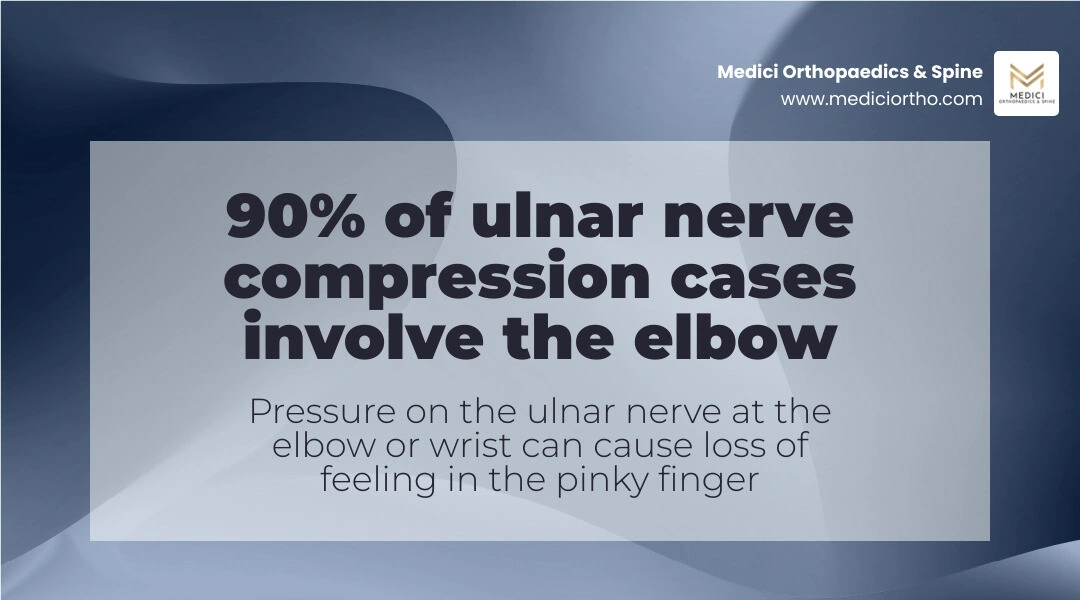
The most common cause is pressure on the ulnar nerve, which carries feeling to the pinky and part of the ring finger. That pressure often happens at the elbow, especially if you lean on it or keep it bent for long periods. It can also happen at the wrist. A neck problem, injury, or peripheral neuropathy can cause similar numbness. An unexpected loss of feeling in pinky finger sensation is often a sign that the ulnar nerve is being compressed somewhere along its path.
If the feeling returns after you change position, the nerve may have been under temporary pressure. If numbness lasts, keeps coming back, or comes with hand weakness, get it checked. Seek emergency care if it starts suddenly with facial drooping, trouble speaking, or weakness in an arm or leg.
I'm Sonny Dosanjh, M.D., a board-certified physical medicine and rehabilitation physician with fellowship training in pain management. At Medici Orthopaedics & Spine, I regularly help patients experiencing a persistent loss of feeling in pinky finger and hand areas, evaluating nerve and spine symptoms to help you find the right next step.
Related conditions and symptoms at a glance:
When you notice a loss of feeling in pinky finger areas, the culprit is almost always rooted somewhere along the intricate pathway of the ulnar nerve. Branching from the brachial plexus in your neck, this nerve travels down your arm, rounds the inside of your elbow, crosses the wrist, and supplies both motor function and sensation to your pinky and the outer half of your ring finger.
Because this nerve navigates several narrow anatomical spaces, localized entrapment or compression can happen in distinct zones. Understanding signs and treatment of cubital tunnel and related entrapments helps identify why the sensation disappeared.
Cubital tunnel syndrome: This involves compression at the medial elbow (cubital tunnel). It can cause numbness in the entire pinky, the ulnar half of the ring finger, and the back of the hand. Common triggers include prolonged elbow bending, leaning on the elbows, and sleeping with the arms curled.
Guyon’s canal syndrome: This occurs at the wrist in the ulnar canal. Numbness typically affects the palm-side of the pinky and half of the ring finger. Direct pressure on the palm, cycling, and repetitive wrist extension are common triggers.
Cervical radiculopathy: This starts at the neck, where the C8–T1 nerve roots may be irritated or compressed. Symptoms can include numbness in the pinky, medial forearm, and hand, often related to a herniated disc, spinal stenosis, or cervical arthritis.
Cubital Tunnel Syndrome is the second most common peripheral nerve entrapment disorder in the upper body, surpassed only by carpal tunnel syndrome. It occurs when the ulnar nerve becomes irritated, pinched, or stretched as it passes through the cubital tunnel—a narrow passageway of bone, ligament, and muscle behind the medial epicondyle (commonly known as your "funny bone").
When your elbow bends past 90 degrees, the cubital tunnel narrows significantly, stretching the nerve over the bony ridge like a guitar string pulled over a fret. Modern daily habits, such as hours spent scrolling on smartphones or working on poorly positioned desks, place steady mechanical tension on this pathway. Addressing this early protects against long-term Hand and Wrist Pain and Injuries.
Further down the arm, the ulnar nerve enters the hand through Guyon's canal, a fibro-osseous tunnel located between the pisiform and hamate bones in the wrist. When compression occurs here, it is referred to as Guyon's canal syndrome or ulnar tunnel syndrome.
This condition is frequently seen in long-distance cyclists who place prolonged, heavy pressure on their handlebars—often dubbed "handlebar palsy." Other common triggers include:
Unlike elbow compression, Guyon's canal syndrome often spares the dorsal (back) sensory branches of the hand, confining numbness strictly to the palmar surface of the pinky and ring fingers.
Not all pinky numbness originates in the arm or wrist. Systemic metabolic disorders, such as diabetes, alcohol-related nerve degradation, or vitamin deficiencies (B1, B6, B12), can cause peripheral neuropathy. These systemic issues typically develop symmetrically, frequently affecting the feet and toes before moving into the hands.
Alternatively, nerve irritation can begin at the spine. If a cervical disc herniates or bone spurs narrow the spinal openings at the C8 and T1 levels, it can trigger cervical radiculopathy, projecting radiating numbness and tingling all the way down into your little finger, producing a loss of feeling in pinky finger sensation that mirrors elbow or wrist entrapment. Recognizing distinct Hand Nerve Damage Symptoms allows us to pinpoint whether the root problem sits in your neck, elbow, or hand.
Accurate diagnosis begins with a comprehensive physical examination. During an evaluation, we perform specific clinical tests, including Tinel's sign (lightly tapping over the cubital tunnel or Guyon's canal to see if it reproduces tingling) and elbow flexion tests.
Reviewing published medical research on pinky numbness causes reinforces that electrical diagnostic tests—specifically Electromyography (EMG) and Nerve Conduction Velocity (NCV) studies—provide objective measurement of how quickly electrical signals move through the ulnar pathway, showing exactly where a blockage occurs.
While most cases develop gradually from mechanical pressure, sudden numbness can signal a systemic or neurological emergency. Seek immediate medical attention if your pinky numbness occurs with:
If left unchecked, chronic nerve compression progresses from intermittent sensory numbness to permanent motor deficit. Because the ulnar nerve controls the small intrinsic muscles of the hand, untreated entrapment can lead to noticeable muscle wasting (atrophy) between the thumb and index finger, an inability to spread your fingers apart, and a weakened grip.
In severe, chronic cases, the ring and little fingers can curl into a "claw hand" posture. Addressing finger coordination loss and nerve pain in the early stages prevents these structural and functional deficits from becoming permanent.
Most individuals suffering from ulnar nerve irritation find significant relief through conservative, non-surgical approaches. By reducing mechanical pressure, allowing the inflamed nerve tissue to rest, and restoring full mobility to the surrounding soft tissue, your hand can regain its normal sensory baseline.
Nerve gliding (or nerve flossing) exercises encourage the ulnar nerve to slide smoothly through the cubital tunnel and Guyon's canal, clearing minor soft-tissue adhesions and reducing local inflammation.
The Ulnar Nerve Glide:
Wrist Flexor Stretch:
Pronator Teres Stretch:
Note: If any exercise triggers sharp pain, electrical shocks, or worsens your numbness, stop immediately and consult your physician.
When lifestyle modifications and home exercises need additional clinical support, we utilize multidisciplinary interventions to target local inflammation and pain pathways. Exploring various causes and treatments for hand nerve pain reveals several conservative and procedural options:
Waking up with a numb pinky is often caused by your sleeping posture. Many people unconsciously sleep in a fetal position with their elbows tightly bent, or tuck their arms under their pillows or bodies. This prolonged elbow flexion stretches and compresses the ulnar nerve for hours at a time. Using an elbow splint or loosely wrapping a towel around your elbow at night can keep the joint extended and eliminate morning symptoms. You can review our detailed Finger Tingling Causes Guide for more insights on nocturnal nerve irritation.
Yes. Prolonged smartphone use—frequently called "cell phone elbow"—requires holding your arm in continuous, tight elbow flexion while supporting the phone's weight. Over time, this sustained posture strains the ulnar nerve in the cubital tunnel. Switching hands regularly, using hands-free devices, or resting your arms on supportive cushions can quickly alleviate this strain.
While a heart attack can cause radiating discomfort, pressure, or numbness down the left arm, it typically presents with central chest pain, shortness of breath, nausea, and lightheadedness. An isolated cold, numb pinky finger without systemic symptoms is far more likely due to ulnar nerve compression or localized Raynaud's phenomenon. The ulnar nerve helps regulate microvascular blood flow to the pinky side of your hand; when irritated, it can cause the finger to feel cold, tingle, or temporarily turn pale.
A persistent loss of feeling in pinky finger and hand regions is your nervous system's way of signaling that something is compressing or irritating the pathway of your ulnar nerve. Whether caused by daytime desk habits, sleeping positions, or cervical spine dynamics, early evaluation is the most reliable way to prevent chronic nerve injury, restore your grip, and safeguard your hand dexterity.
At Medici Orthopaedics & Spine, our team provides comprehensive, patient-centered diagnostics and minimally invasive solutions across our clinics in Buckhead, Snellville, and Kennesaw, as well as our surgery centers in Marietta and Snellville, GA. If you are experiencing persistent finger numbness or progressive hand weakness, explore our specialized care for neuropathy and neuralgia or schedule an evaluation with our team.
At Medici, you’re more than your MRI.
We take time to hear your story, understand your pain, and create a plan that actually works for you.

Our team delivers specialist care at convenient locations across Metro Atlanta:
Get expert tips on injury recovery, pain relief, joint health, and movement strategies—straight from our Fellowship-Trained team.






