
Shoulder pain from a mattress is more common than most people realize — and it is often the last thing they think to check. If you wake up with a stiff, aching shoulder that loosens up after 20 or 30 minutes of moving around, your sleep surface may be working against you all night long.
Quick Answer: What causes shoulder pain from a mattress?
Shoulder pain is the third most common musculoskeletal complaint after back and neck pain, affecting roughly one in three adults at some point. And with nearly 70% of adults sleeping on their side, the shoulder takes a significant beating every single night.
The good news? In many cases, identifying the source of the problem — your mattress — is the first step toward real relief.
I'm Sonny Dosanjh, M.D., board-certified in Physical Medicine & Rehabilitation and fellowship-trained in Multidisciplinary Pain Management at Emory University, where I regularly help patients untangle the root causes of shoulder pain from mattress and sleep-related joint stress. As the founder of Medici Orthopaedics & Spine, I've seen how often a simple change in sleep setup can dramatically reduce chronic shoulder discomfort before any clinical intervention is needed.
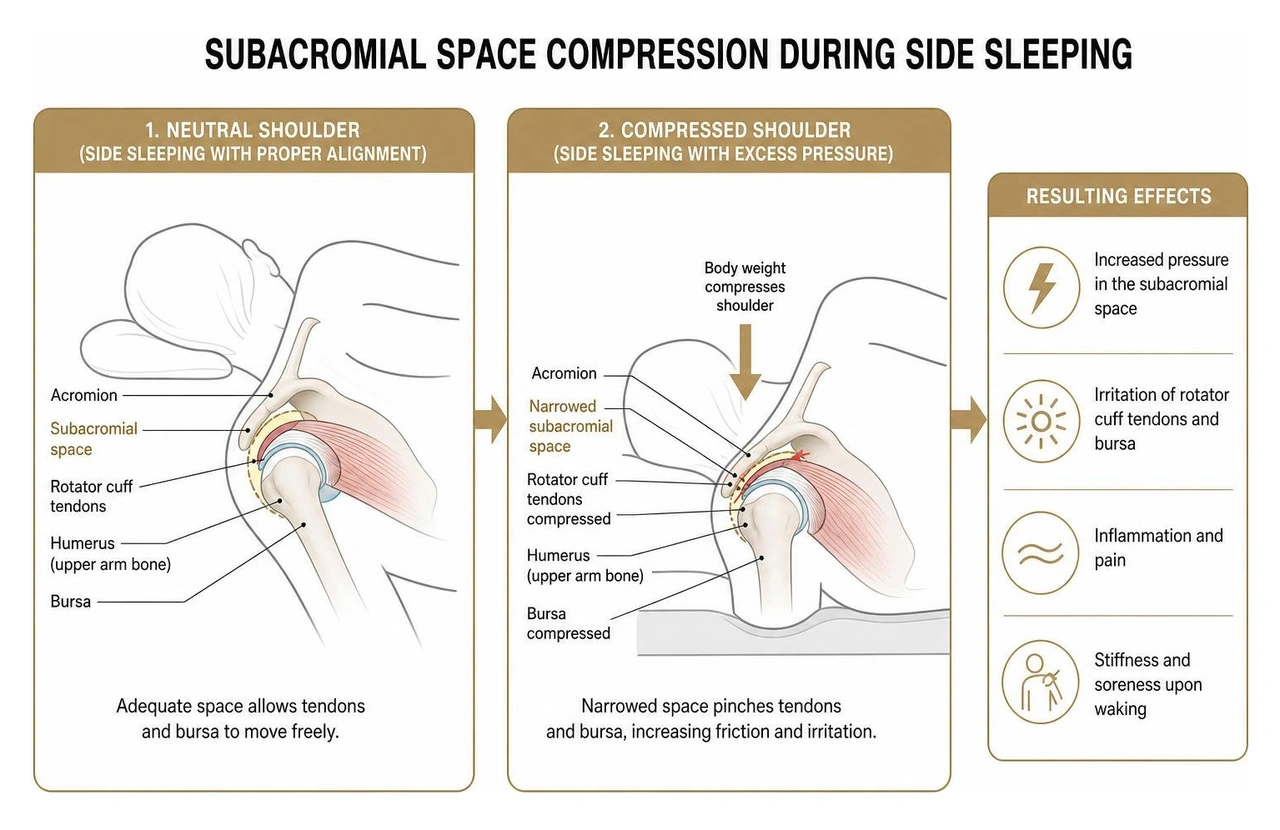
To understand why your mattress is giving you the cold shoulder, we have to look at the unique anatomy of this highly mobile joint. Unlike the hip, which is a deep, stable ball-and-socket joint designed to bear your body weight, the shoulder is built for maximum range of motion. It is a shallow joint, often compared to a golf ball sitting on a tee, secured primarily by a complex network of muscles, tendons (the rotator cuff), and ligaments.
During the day, your shoulder muscles are active, continuously stabilizing the joint. But when you drift off to sleep, muscle tension naturally decreases. This leaves the anatomical structures of the shoulder vulnerable to external mechanical forces.
When you lie on your side on a mattress that does not cooperate with your body, several biomechanical issues occur:
Before you assume that your morning stiffness requires a surgical fix, it is essential to explore how your sleep environment is loading your joints. Many of our patients in Metro Atlanta are relieved to learn that Not Every Shoulder Injury Needs Surgery. Often, managing the biomechanics of how you rest can prevent minor tissue irritation from turning into a chronic injury.
How can you tell if your morning aches are truly a shoulder pain from mattress issue, or if they point to an underlying medical condition?
The easiest diagnostic clue is the timeline of your pain. If you wake up with a deep, dull ache or a "dead arm" sensation that slowly improves within 20 to 30 minutes of stretching and moving, your mattress is likely the culprit. During the day, constant movement provides intermittent loading and decompression to the joint, which keeps tissues lubricated. At night, spending six to eight hours pinned in a single, unsupportive position creates localized tissue ischemia (restricted blood flow) and joint stiffness.
Another great test is the "hotel check." If you find that your shoulder pain mysteriously vanishes when you travel and sleep on high-quality hotel beds, your home mattress is begging for retirement.

To help you evaluate your current sleep setup, we have compiled a guide comparing mattress firmness levels by sleep position and body weight:
| Sleep Position | Body Weight | Ideal Firmness Range (1-10 Scale) | Biomechanical Explanation |
|---|---|---|---|
| Side Sleeper | Under 130 lbs | Medium-Soft (3 - 4) | Lighter bodies need a softer comfort layer to allow the shoulder to sink in enough to decompress the joint. |
| Side Sleeper | 130 - 230 lbs | Medium to Medium-Firm (4 - 6) | Balances essential shoulder contouring with enough core support to keep the spine horizontal. |
| Side Sleeper | Over 230 lbs | Medium-Firm (6 - 7) | Requires a thicker comfort layer over a highly supportive coil system to prevent bottoming out. |
| Back Sleeper | Any Weight | Medium-Firm (5 - 6.5) | Keeps the thoracic spine aligned while providing light cushioning for the shoulder blades. |
| Stomach Sleeper | Any Weight | Firm (7 - 9) | Prevents the pelvis from sagging, though stomach sleeping is generally discouraged for shoulder and neck health. |
If your mattress is older than 7 to 10 years, it has likely begun to sag. Sagging coils and deep body impressions mean the mattress can no longer distribute your weight evenly.
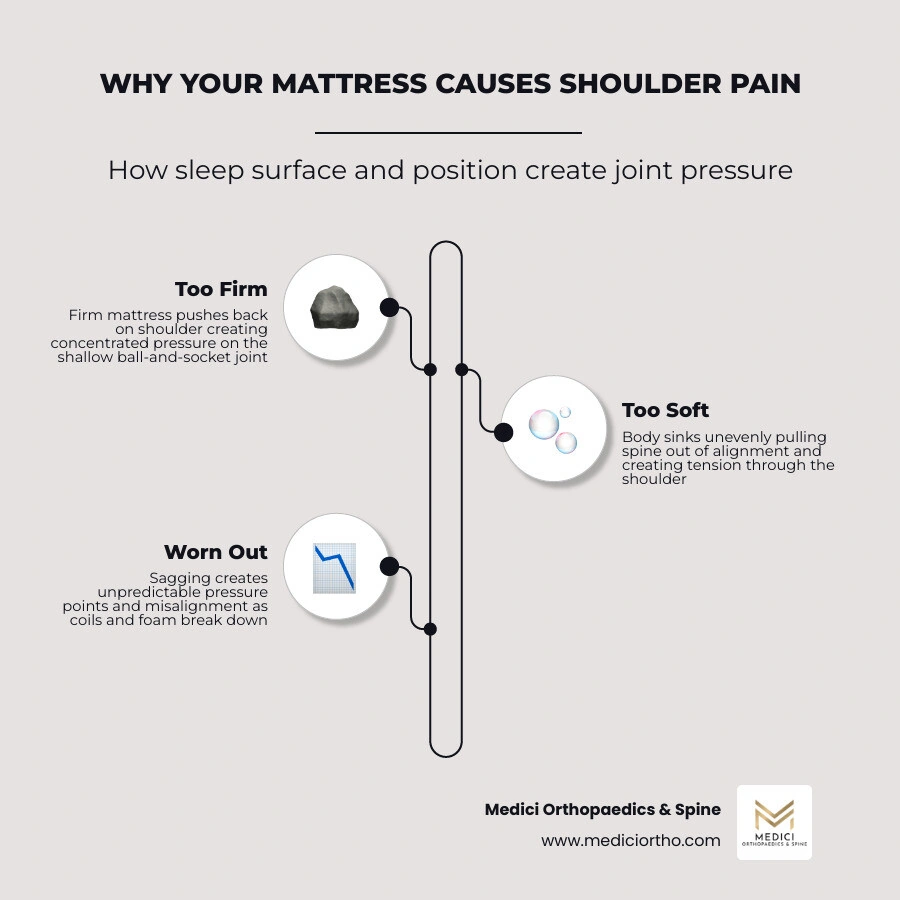
When a mattress loses its structural integrity, your heavier midsection sinks deeper than your shoulders and head. This creates a vertical pulling force that drags your shoulder joint out of its socket alignment, placing immense strain on the ligaments. If you can see visible dips in your bed, or if you find yourself constantly rolling toward the center of the mattress, the resulting spinal misalignment is actively worsening your joint pain. You can read more about how sleep surfaces degrade and impact your body in this detailed guide on The Link Between Your Bed and Shoulder Pain.
The old-school advice was that a hard mattress is always best for joint pain. We now know that this advice is incomplete and, for side sleepers, downright detrimental.
A mattress that is too firm pushes back aggressively against your shoulder, concentrating your entire upper body weight onto the small surface area of the acromion and lateral deltoid. This creates severe pressure points, restricts local circulation, and leads to that familiar, painful tingling.
Conversely, a mattress that is too soft fails to support your waist and lower back. Your torso sags, which forces your shoulder to bear an unnatural load to keep you balanced. The key is finding a mattress that balances surface pressure relief with deep structural support, a concept explored in depth by sleep experts analyzing Why Mattress Firmness Affects Shoulder Comfort More Than You Think – SweetNight.
When shopping for a new mattress to alleviate joint pain, you will want to look for materials that excel at pressure distribution. A high-quality mattress should act as a pressure-relieving device, shifting your body weight away from prominent joints like the shoulders and hips and dispersing it across your entire body surface.
Different mattress materials interact with your body in distinct ways:
To explore how high-quality construction materials can transform your sleep quality, check out the engineering insights on how mattresses cushion joints in Can a Mattress Help Shoulder Pain? - Azure.
In 2026, mattress engineering has advanced significantly, making zoned support systems a standard recommendation for patients with chronic joint pain.
A zoned mattress does not have a uniform firmness level from head to toe. Instead, it is divided into distinct zones designed to match your anatomy. The zone beneath your shoulders is engineered to be softer and more adaptive, allowing your shoulder joint to sink in comfortably and decompress. Meanwhile, the zone beneath your lower back and pelvis is firmer, preventing your hips from sagging and keeping your spine in perfect, neutral alignment.
Investing in a zoned support system resolves the classic "soft vs. firm" paradox, giving you targeted relief exactly where you need it. You can read more about the best-tested zoned models in the comprehensive review of the Best Mattress for Shoulder Pain 2026: Why Most Advice Is Wrong.
If you are not ready to purchase a new mattress today, there are several immediate adjustments you can make to protect your shoulders and improve your sleep quality tonight.

First, let's talk about pillow loft (thickness). Your pillow's primary job is to fill the gap between your ear and the mattress, keeping your neck in a neutral, horizontal position.
If you are dealing with chronic discomfort, exploring conservative, non-surgical options is always the best first step. Our team specializes in helping patients learn How to Manage Chronic Pain Without Surgery through personalized rehabilitation and biomechanical coaching.
To protect your joints immediately, try these actionable steps tonight:
For patients managing recurrent joint issues, maintaining proper mechanics during rest is crucial. You can learn more about protecting your joint integrity in our clinical guide on How to Prevent Shoulder Dislocation Recurrence.
If you go to bed feeling fine but wake up with a dull, aching shoulder that gradually improves within half an hour of moving around, your mattress is likely the culprit. Other warning signs include waking up frequently to switch sides because your shoulder feels numb, or noticing visible sagging, dips, or body impressions in your mattress.
For a deeper look into how a degrading sleep surface impacts your body, read Is Your Mattress Causing Shoulder Pain? | Ausbeds to help determine if it is time for an upgrade.
The absolute best position for shoulder recovery is back sleeping. This position distributes your body weight evenly across your entire back, completely unloading your shoulder joints.
If you must sleep on your side, sleep on the unaffected side and use a hugging pillow to keep your painful shoulder from collapsing forward. If you absolutely have to sleep on your sore side, use a zoned mattress or a thick mattress topper to cushion the joint, and roll slightly backward onto a body pillow to relieve direct pressure.
For more tips on managing nighttime aches, read our guide on Shoulder Ache From Sleeping | Mattress Miracle.
Yes, a high-quality 2-to-3-inch memory foam or natural latex mattress topper can be an excellent, cost-effective short-term fix if your current mattress is too firm. It adds a plush comfort layer that allows your shoulder to sink in and decompress.
However, please note that a mattress topper cannot fix a sagging mattress. If your bed has deep dips or worn-out coils, a topper will simply follow those same sagging contours, leaving your spine misaligned and your shoulder under strain.
Waking up in pain is a sign that your body is working against its environment rather than resting and recovering. While finding the right balance of mattress pressure relief and spinal alignment is a vital step toward waking up refreshed, sometimes persistent joint pain requires a professional evaluation.
At Medici Orthopaedics & Spine, led by Dr. Sonny Dosanjh, M.D., we are dedicated to helping patients in Metro Atlanta restore their quality of life. We believe in delivering highly effective, minimally invasive, non-surgical treatments tailored to your unique lifestyle. Whether your pain stems from a stubborn mattress issue, a rotator cuff tear, or referred nerve discomfort, our team is here to help you find lasting relief.
If joint or spinal discomfort is keeping you awake, you might also find our guide on How to Sleep Better with a Herniated Disc helpful for restoring your nightly rest.
Don't let chronic shoulder pain steal another night of deep, restorative sleep. Contact us at any of our convenient Metro Atlanta locations to schedule your comprehensive evaluation:
We look forward to helping you optimally restore your mobility, comfort, and quality of life!
At Medici, you’re more than your MRI.
We take time to hear your story, understand your pain, and create a plan that actually works for you.

Our team delivers specialist care at convenient locations across Metro Atlanta:
Get expert tips on injury recovery, pain relief, joint health, and movement strategies—straight from our Fellowship-Trained team.