
If you're searching for shoulder pain sleep solutions, here are the most effective approaches:
Shoulder pain doesn't just hurt during the day. For millions of people, it gets worse the moment they lie down.
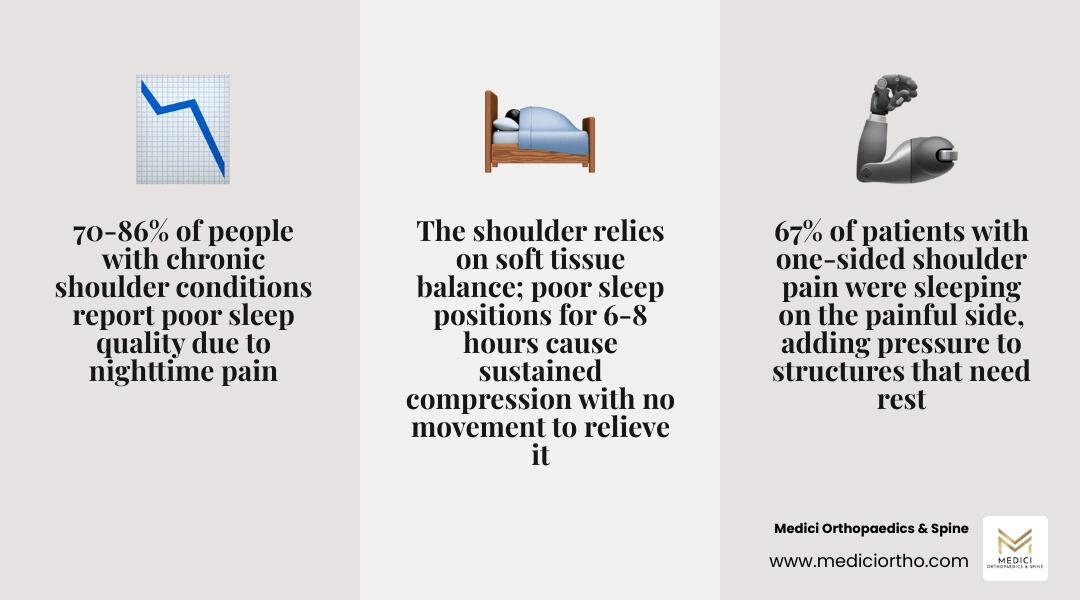
Research backs this up. Between 70 and 86% of people with chronic shoulder conditions report poor sleep quality because of nighttime pain. And it's not random — 67% of patients with one-sided shoulder pain were sleeping on that exact side, compressing the very structures that needed rest to heal.
The shoulder is one of the most mobile joints in the body. That mobility comes at a cost: it relies on a delicate balance of tendons, bursae, and rotator cuff muscles to stay stable. When you sleep in a poor position for six to eight hours, you're putting sustained pressure on those structures — and there's no movement to relieve it.
The result? You wake up more sore than when you went to bed.
I'm Sonny Dosanjh, M.D., board-certified in Physical Medicine & Rehabilitation and fellowship-trained in Multidisciplinary Pain Management through Emory University — and helping patients find effective shoulder pain sleep solutions is a core part of the orthopedic and pain management care we provide at Medici Orthopaedics & Spine. Whether your pain stems from a rotator cuff injury, bursitis, frozen shoulder, or chronic joint wear, the right approach to sleep can make a measurable difference in how fast you recover.
To understand why your shoulder throbs the minute your head hits the pillow, we have to look at the unique anatomy of the shoulder joint. The shoulder is a shallow ball-and-socket joint. Unlike the hip, which is deep and inherently stable, the shoulder relies almost entirely on soft tissue—muscles, tendons, and ligaments—to keep the arm bone centered.
When you lie down, gravity stops working in your favor. During the day, gravity pulls your arm down, naturally creating space in the joint. But when you lie flat, that natural distraction disappears.
If you sleep on your side, you place the entire weight of your torso directly onto the shoulder joint. This causes immediate joint compression, squeezing the subacromial space. This space is already incredibly tight—averaging only about 1 to 1.5 centimeters in width. Within this tiny gap lie the rotator cuff tendons and the subacromial bursa (a fluid-filled sac that prevents friction).
Continuous compression from side-sleeping:
Even if you don't sleep directly on the painful side, sleeping in an awkward position can cause significant rotator cuff strain. For instance, letting your arm dangle across your body or resting with your arm tucked under your pillow stretches the joint capsule and tendons to their absolute limits. If you want to dive deeper into how sleeping wrong impacts your body, check out our guide on How to Prevent Shoulder Pain from Sleeping Wrong: Tips from Atlanta's Spine Specialists.
The goal of any sleep modification is to achieve a neutral shoulder position. This means keeping the joint in a relaxed, mid-range alignment where tendons aren't stretched tight and the subacromial space isn't compressed.
Sleeping on your back is the absolute best position for shoulder pain relief. It distributes your body weight evenly and keeps the shoulder joint open.
If you are a die-hard side sleeper, you don't have to completely abandon your preferred style. You just need to modify it.
For acute flare-ups, severe rotator cuff tears, or during the first few weeks after shoulder surgery, flat sleeping may feel impossible.
Different shoulder injuries respond to different mechanical setups. What works for a frozen shoulder might not feel comfortable for someone recovering from an acute dislocation.
Rotator Cuff Tear
Shoulder Impingement
Subacromial Bursitis
Frozen Shoulder
Shoulder Dislocation
A staggering 89.7% of patients with rotator cuff tears are habitual side sleepers, which suggests that years of direct compression may actually contribute to the degenerative tearing of these tendons. When a tear is present, the tendon is incredibly sensitive to tension.
Sleeping on your back with a pillow supporting the arm keeps the tendon in its shortest, most relaxed state, facilitating healing. If your nighttime routine isn't giving you the relief you need, read through the Rotator Cuff Shoulder Pain at Night: Sleep Recovery Guide - Night Time Comfort for additional recovery insights.
Impingement occurs when the rotator cuff tendons scrape against the bone above them. Bursitis is the painful swelling of the lubricating sac nearby. Both conditions are highly pressure-sensitive.
For these inflammatory issues, the goal is to maximize the subacromial space. Side sleeping on the non-affected side with a pillow-hug setup is ideal. For those struggling with broader joint wear alongside impingement, exploring options like Non-Surgical Treatment for Shoulder Arthritis can help you manage daytime inflammation so it doesn't spill over into your nights.
Frozen shoulder causes severe capsule tension and progressive stiffness. Because the joint capsule shrinks and tightens, any position that stretches the capsule will wake you up with a sharp, stabbing pain.
We recommend the "Double-Pillow" trick: sleep on your back, place one pillow under your head, and tuck a second, thinner pillow slightly under the shoulder blade and upper arm of your frozen side. This keeps the joint capsule slightly forward, minimizing overnight tension.
If you have a history of instability, your main goal is to prevent the shoulder from rolling into positions of vulnerability (abduction and external rotation). Sleeping on your back with a pillow firmly tucked under the armpit and elbow prevents the arm from falling outward.
To learn more about keeping your shoulder secure, see our guide on Preventing Shoulder Dislocations: Techniques Every Athlete Should Know.
Your mattress and pillows are the foundation of your sleep ergonomics. If your mattress is too firm, it won't yield to your shoulder, forcing your joint to absorb the pressure. If it is too soft, your torso will sink, throwing your neck and shoulders out of alignment.
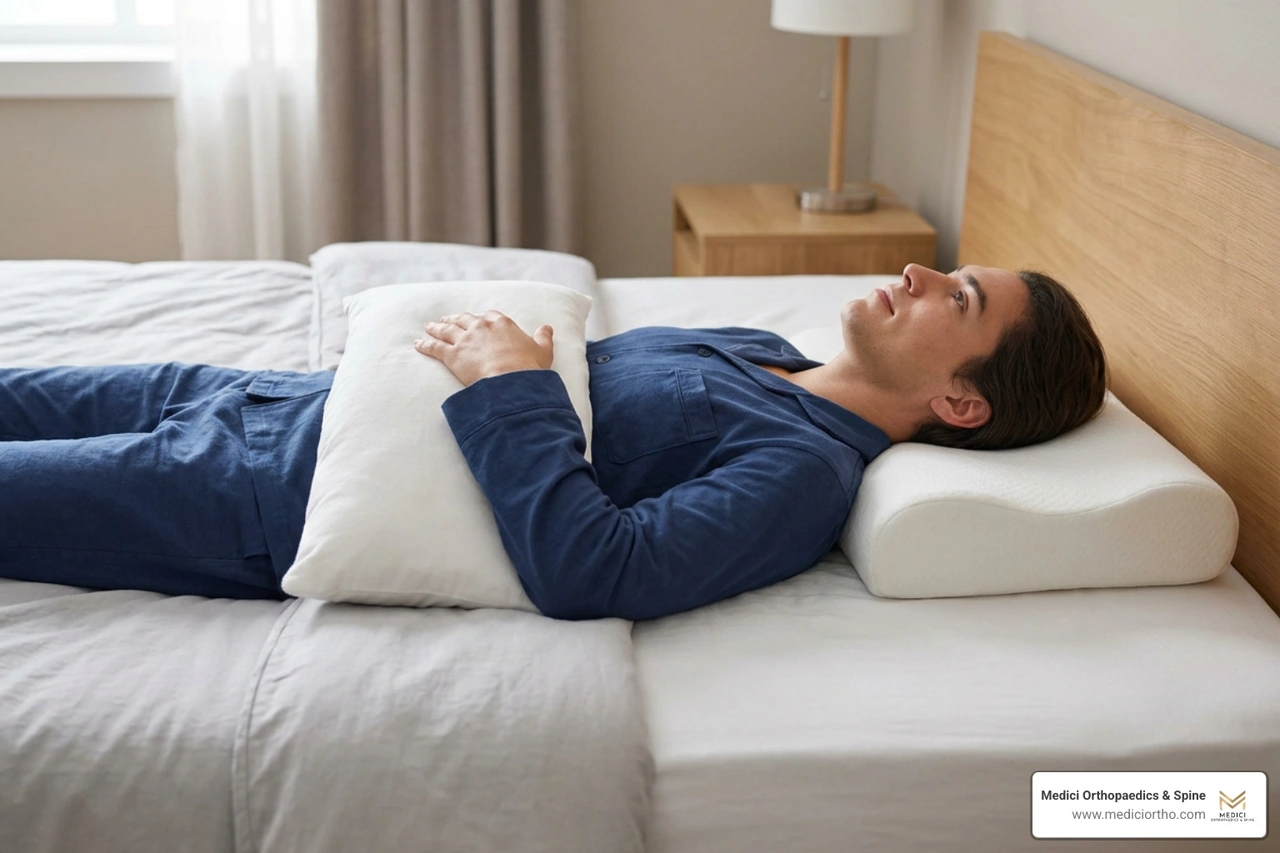
A medium-firm mattress is generally ideal for shoulder pain. It provides enough support to keep your spine aligned while offering enough "give" to cushion the shoulder joint.
Pillow selection isn't just about comfort; it's about maintaining proper pillow loft (height) to keep your head, neck, and shoulders in a straight line.
Preparing your shoulder for sleep is just as important as your physical sleep setup. Taking a few minutes to calm the nervous system and gently mobilize the joint before bed can reduce nighttime pain by up to 40%.
Here is a quick, 7-minute micro-routine to do right before you get into bed:
Tip: Keep your bedroom temperature cool (between 18–20°C or 65–68°F). A cooler room supports deeper sleep and naturally reduces the body's systemic inflammatory response.
There are several biological reasons for this frustrating phenomenon:
If you are recovering from surgery or a severe acute injury, your doctor may instruct you to sleep in a sling to prevent accidental movement. However, for chronic conditions like frozen shoulder or mild rotator cuff tears, prolonged immobilization overnight should be avoided. Restricting movement completely can lead to joint stiffness and accelerate the onset of adhesive capsulitis.
While sleep modifications and stretches can help, they are coping mechanisms—not a cure for structural damage. You should seek a professional medical evaluation if you experience any of the following "red flags":
If you live in the Metro Atlanta area, consulting a Shoulder Pain Specialist Near Marietta is the best way to get an accurate diagnosis and a customized recovery plan.
Finding the right shoulder pain sleep solutions is a vital first step toward reclaiming your nights and accelerating your body's natural healing process. By adjusting your sleep posture, optimizing your pillow setup, and incorporating a gentle pre-bed routine, you can significantly reduce nighttime irritation.
However, if structural damage or chronic inflammation is keeping you awake, positioning alone may not be enough. At Medici Orthopaedics & Spine, we specialize in non-surgical, minimally invasive treatments designed to target the root cause of your pain. Led by Dr. Sonny Dosanjh, M.D., our team offers comprehensive care including physical therapy, regenerative medicine, joint injections, and advanced interventional treatments across our convenient locations in Snellville, Kennesaw, Buckhead, and Marietta.
We are committed to helping you restore your quality of life. Whether you are dealing with shoulder issues or looking for tips on How to Sleep Better with a Herniated Disc, we are here to support you.
Don't let shoulder pain dictate your sleep. Visit Medici Orthopaedics & Spine to schedule your personalized evaluation.
At Medici, you’re more than your MRI.
We take time to hear your story, understand your pain, and create a plan that actually works for you.

Our team delivers specialist care at convenient locations across Metro Atlanta:
Get expert tips on injury recovery, pain relief, joint health, and movement strategies—straight from our Fellowship-Trained team.