It usually starts around midnight. Your knee has been aching for months, maybe years, and tonight it finally won a round against your patience. So you pick up your phone. You type the question so many people type before you: best doctor for knee replacement near me.
The search results pile up fast. Star ratings, practice names, unfamiliar credentials, and no clear way to know who actually deserves your trust.
This is not a small decision. The surgeon you choose will shape how you walk and move through your days. That effect can last for years.
You deserve more than a list of names. You deserve to understand what actually makes a surgeon the right fit for you. And you deserve to know what a genuinely good evaluation looks like before anyone mentions surgery.
Surgeons who perform knee replacements regularly tend to produce more consistent, predictable outcomes. This is not about ego or prestige. It is about repetition building precision.
Think of it the way you would think about any skilled trade. A carpenter who builds cabinets every week works differently than one who builds one a year. The same logic applies here.
A general orthopedist who handles the occasional knee case is different from one who focuses heavily on joint replacement. Ask directly how often a surgeon performs this procedure. The answer tells you a lot.
It is also worth asking how many of those procedures involve cases similar to yours. A surgeon used to straightforward cases may approach a complex revision differently. Someone who regularly handles harder cases may feel more confident there.
Robotic assisted knee replacement has changed what recovery can look like for many patients. The technology allows for smaller incisions and more precise implant placement. It often supports a faster return to normal movement.
Not every surgeon offers this option, and not every patient needs it. Still, it is worth asking directly whether robotic assistance is available and whether it fits your specific case.
The technology works by mapping your unique knee anatomy before the procedure even begins. This allows the surgeon to plan implant positioning with a level of accuracy that is hard to match with traditional tools. For many patients, this means less soft tissue disruption. Recovery often follows a smoother early path.
That said, robotic assistance is a tool, not a guarantee. The surgeon's skill in interpreting that data and executing the plan still matters more than the equipment itself.
The best knee surgeons rarely jump straight to surgery. A thoughtful provider will explore other paths first, including:
Credentials matter, even if they feel technical. Look for board certification in orthopedic surgery. Fellowship training in joint replacement and active hospital affiliations matter too. These details confirm a surgeon meets rigorous, ongoing standards, not just a one time qualification.
Understanding the procedure itself helps you gauge a surgeon's transparency. Consider asking:
Recovery is where daily life actually happens after surgery. It helps to know what to expect before you commit. Ask about:
Recovery rarely happens through one provider alone. Ask whether the surgeon works closely with physical therapists and pain management specialists. Regenerative medicine providers matter here too. Coordinated care tends to produce smoother, more supported recoveries.
A good surgeon asks about your daily life, your pain patterns, and your goals before suggesting anything. Recommendations should follow a real evaluation, not precede it.
Every surgery carries risks and realistic limitations. A trustworthy surgeon walks you through both the benefits and the trade-offs. They won't promise a perfect outcome.
Look for a practice where physical therapy, pain management, and surgical follow-up exist under one coordinated system. This spares you the burden of piecing together care between separate offices.
Dr. Daren Newfield brings a minimally invasive philosophy to orthopedic surgery at Medici Orthopaedics & Spine. His approach favors precision techniques. These techniques support faster recovery and less disruption to surrounding tissue.
That philosophy fits naturally into Medici's broader mission. The goal is always the most effective, least invasive, least drug-dependent care available. Surgery is never the starting point here. It is one option among many, considered carefully and only when appropriate.
Many knee patients benefit from more than one type of care. Dr. Newfield's surgical expertise works alongside Dr. Sonny Dosanjh's interventional pain management.
Physical therapy and regenerative medicine options come into play when a patient's case calls for it.
This kind of collaboration means your treatment plan can shift and adapt as your needs change. You are not locked into a single path the moment you walk through the door.
Your first visit typically includes a conversation about your symptoms and a physical evaluation. Imaging follows if needed. This is where the team builds a clear picture of what is happening in your knee.
Nothing is assumed before this evaluation takes place. Every recommendation that follows is based on your specific situation.
You will have time to describe how your knee pain affects your work, sleep, and daily activities. That context matters just as much as any scan. It shapes what a meaningful recovery looks like for you.
Not every patient needs surgery right away, and some may never need it at all. Your plan might include physical therapy, injections, or regenerative treatments first. These options are often combined before surgery is ever discussed.
If surgery does become the right option, you will already have a relationship with a team that understands your history and goals.
This continuity matters more than most people expect. Starting fresh with a new surgeon often means repeating tests and retelling your history. It can cost you valuable time. A coordinated plan avoids that gap.
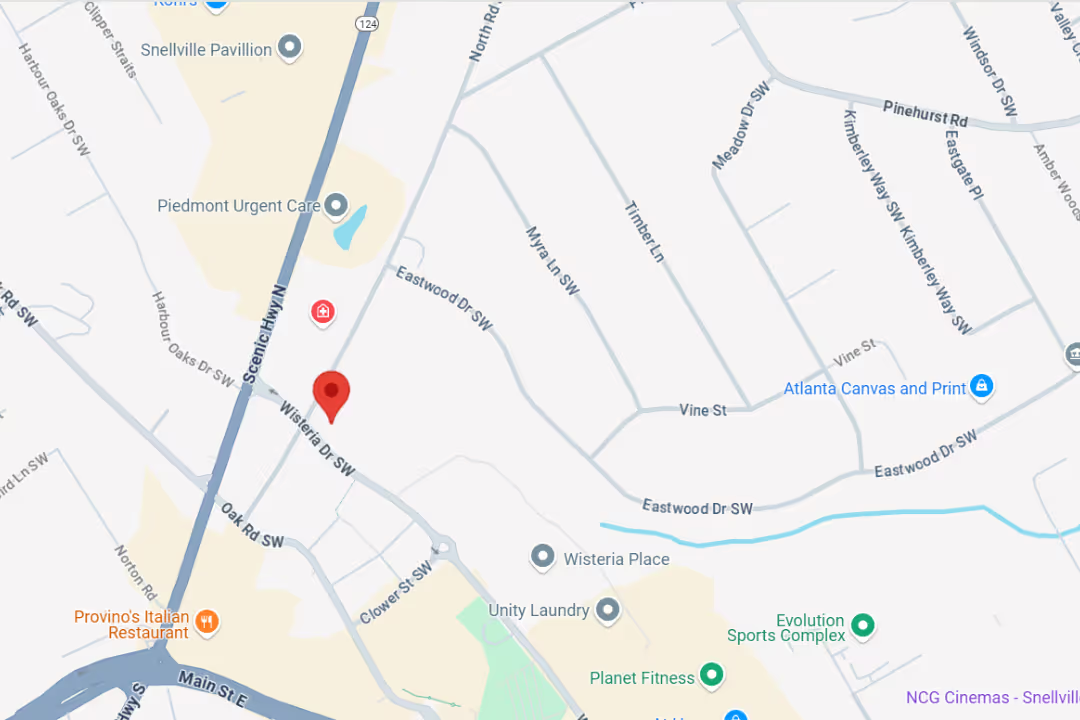
Medici Orthopaedics & Spine serves patients across the greater Atlanta area. Locations are designed to make care accessible no matter where you live or work. Clinics sit in Kennesaw, Snellville, and Buckhead. Ambulatory surgery centers in Marietta and Snellville support surgical procedures close to home.
Whether you are coming from the northwest suburbs or closer to the city, there is likely a Medici location within reach.
Choosing a knee surgeon is not really about finding a name on a list. It is about reclaiming what pain has quietly taken from you.
Walking the dog without wincing. Keeping up on the golf course. Getting down on the floor with your grandkids without a second thought.
That kind of decision deserves care, patience, and a team willing to listen before recommending anything. You do not have to figure this out alone. And you do not have to rush a choice that affects the rest of your mobility.
Pain doesn't have to be your normal, and neither does uncertainty about who to trust with your care. The team at Medici Orthopaedics & Spine is ready to walk you through your options. From conservative treatments to advanced surgical care, honesty guides every step.
Locations:
Explore our library of patient support guides covering the conditions we treat, the treatments we offer, and the questions we hear most. Each one is written to help you understand your options and feel confident about your next step. Browse the topics below to learn more, or reach out to our team anytime.

At Medici, you’re more than your MRI.
We take time to hear your story, understand your pain, and create a plan that actually works for you.

Our team delivers specialist care at convenient locations across Metro Atlanta:
Get expert tips on injury recovery, pain relief, joint health, and movement strategies—straight from our Fellowship-Trained team.